
Drip Irrigation vs Sprinklers: Which Makes Sense for Your Bryan/College Station Property?
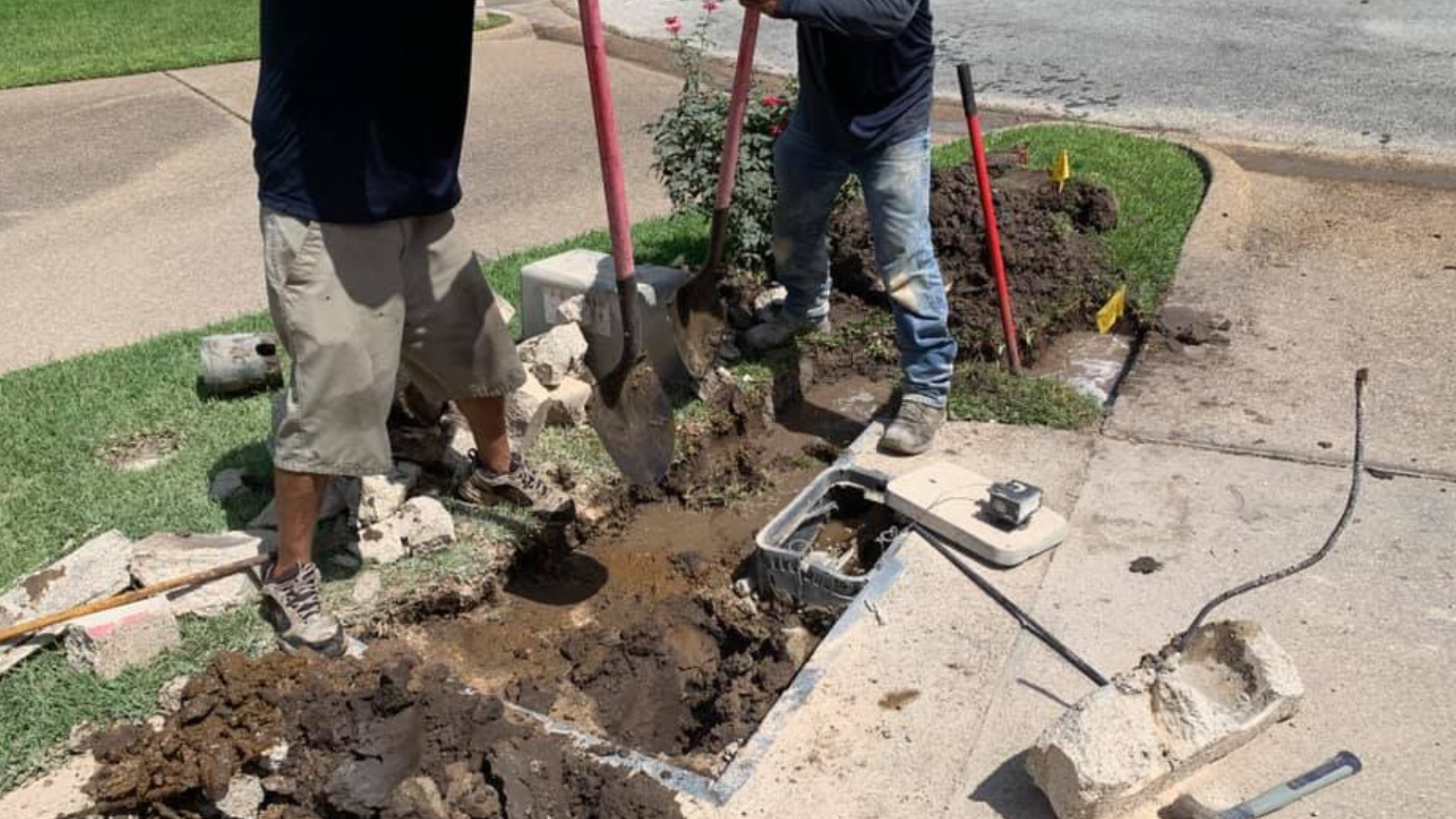
Short Answer: Sprinklers are the right choice for lawns and large turf areas because they deliver even, broad coverage at the volume grass needs. Drip irrigation is the better choice for landscape beds, vegetable gardens, foundation plantings, and ornamental trees because it puts water exactly at the root zone and uses 30 to 50 percent less water than spraying those areas. The best Brazos Valley properties combine both: traditional sprinklers for the lawn, drip lines for everything else. Here is when each approach is worth the investment.
If you are planning a new irrigation system or rethinking an existing one, drip irrigation is probably on your radar. It is more efficient, more targeted, and uses less water than traditional spray heads in many situations. But drip is not the right solution for every part of a property, and switching the wrong areas to drip can leave you with worse results, not better.
Here is how we help homeowners and property managers in Bryan and College Station decide which approach fits where.
How Each System Actually Works
Traditional sprinkler systems use spray heads or rotors that throw water through the air across a defined area. Coverage is broad, output is high, and the goal is to wet a large surface relatively quickly. They work well for lawns because grass benefits from even coverage across the entire area.
Drip irrigation uses tubing with built-in emitters that drip water directly onto the soil at specific points. Output per emitter is low (typically 0.5 to 2 gallons per hour), and coverage is targeted right at root zones rather than broadcast across an area. They work well for plants that have defined root zones (shrubs, perennials, vegetables) rather than continuous coverage like turf.
Both systems can be combined into a single irrigation system controlled by one controller, with separate zones for spray and drip. Modern systems handle this routinely. The combined approach gives you the right tool for each part of the property without requiring two separate systems.
When Sprinklers Win
For lawns, sprinklers are nearly always the right answer. A St. Augustine, Bermuda, or Zoysia lawn needs water across the entire surface area to keep all the grass alive and growing. Drip lines under turf would deliver water in stripes, leaving the spaces between stripes to dry out and brown.
Sprinklers also handle high-volume needs efficiently. A typical lawn zone needs about half an inch of water per cycle. A spray system delivers that in 15 to 30 minutes. A drip system would take many hours to deliver the same volume.
Sprinklers are easier to inspect and maintain. Heads are visible. Coverage problems show up clearly. Repairs are straightforward.
Sprinklers also work well in conditions where the surface needs to be cooled, such as during peak heat to reduce surface temperatures around the home. Drip cannot provide that surface cooling effect because water never reaches the surface broadly. For lawn areas where heat reduction matters, sprinklers serve a dual purpose.
When Drip Wins
For landscape beds, drip is the smarter system. Watering a bed of shrubs with overhead spray wets foliage (which encourages disease), wets mulch (which evaporates fast), and waters spaces between plants where you do not need water at all.
A drip line with emitters at each plant delivers water exactly where the roots are. The plants get more water reliably while the system uses 30 to 50 percent less total. Foundation plantings, vegetable gardens, hedge rows, and mixed perennial beds all benefit dramatically.
Drip is also the right answer for newly planted trees, where deep slow watering at the root ball helps establishment far better than a spray head 10 feet away.
Container gardens and pots respond particularly well to drip. Multi-emitter assemblies can water dozens of containers from a single zone, and watering schedules can match container drying rates more accurately than hand watering. For homeowners with significant container plantings, drip integration is one of the highest-value irrigation upgrades available.
What a Combined System Looks Like
The best Brazos Valley properties we work on use both. Traditional spray zones cover the lawn, sized to deliver 1 to 1.5 inches per week through 2 deep cycles. Separate drip zones handle each landscape bed area, programmed to run for longer durations less frequently.
Each bed often gets its own drip zone because plant water needs vary. A native-plant bed near the foundation might run once a week. A vegetable garden might run daily. Separating them on the controller lets you tune each one independently.
The combined approach also makes water restrictions easier to comply with. When local restrictions limit watering days, drip zones can sometimes operate under exceptions because they apply water so efficiently. Knowing your specific city ordinances and how they treat drip systems can affect both program design and cost over time.
Cost Comparison
For new construction or full system retrofits, drip costs more per linear foot of bed than spray costs per square foot of lawn, but drip uses far less water over time. Most homeowners see lower water bills within the first season after converting beds from spray to drip.
For an existing spray system that needs upgrades, converting just the bed zones to drip while leaving lawn zones on spray is often the highest-value renovation. We can typically retrofit a single bed zone to drip for $200 to $600 depending on length and complexity.
For new full system installations on average-sized residential lots, expect $3,500 to $7,000 for traditional sprinklers covering the lawn, with another $1,500 to $3,500 for integrated drip on landscape beds. The combined investment is significant up front but produces water savings and lawn health benefits over the life of the system.
Common Mistakes
The biggest mistake we see is putting drip lines under turf. It does not provide even coverage and leaves dead spots. If you are watering lawn, use sprinklers.
Second mistake: using drip in beds without a filter. Drip emitters clog with even small amounts of debris in the water. A simple inline filter at the start of the zone prevents this.
Third mistake: failing to inspect drip systems. Because the lines are under mulch and emitters are small, problems are not visible at a glance. We recommend annual inspection of any drip system, lifting mulch in spots and confirming emitters are flowing.
Fourth mistake: using a single emitter per plant. Larger shrubs and trees benefit from multiple emitters distributed around the root zone rather than a single point source. Single-emitter watering produces uneven root development and can stress plants over time, particularly larger trees.
Fifth mistake: running drip the wrong amount of time. Because output per emitter is low, drip zones often need to run 30 to 60 minutes or more, where spray zones run 15 to 30 minutes. Programming drip with spray run times leaves plants underwatered.
Smart Controller Considerations
If you are upgrading the controller along with the system, modern smart controllers handle drip zones beautifully. They can set different schedules for different zones (which matters because drip and spray zones have very different run times) and adjust watering based on weather data automatically.
For a new installation we typically pair a smart controller with the system upgrade because the additional cost is small relative to the water savings over time.
Maintenance Differences
Each system has its own maintenance profile:
Sprinkler maintenance involves head adjustments, nozzle replacements, valve repairs, and seasonal coverage audits. Most parts are visible and accessible.
Drip maintenance involves filter cleaning, emitter inspection, line flushing, and occasional emitter replacement when clogs form. Maintenance is less frequent overall but requires lifting mulch to access the lines.
Both systems benefit from annual professional inspection. The cost is similar; the work is different.
Brazos Valley Specifics
Several factors make our area particularly suited to combined systems:
Heavy clay soils that hold water well, making drip particularly effective for landscape beds where the slow release is absorbed before runoff occurs.
Hot summers that produce significant evaporation losses on spray applications. Drip in beds reduces those losses dramatically.
Native plant landscapes that perform best with deep infrequent watering at the root zone, exactly what drip provides.
Vegetable gardening interest among many homeowners, where drip is by far the best irrigation approach.
Established landscapes with mature trees that benefit from periodic deep root watering through dedicated drip lines.
What to Do Next
If you are considering drip for some part of your Bryan or College Station property, we are glad to come walk it with you. We will look at what you have, what you are trying to accomplish, and where drip makes financial and practical sense. Reach out anytime and we will set up a no-obligation walkthrough.