
July 2026 • Bryan & College Station, TX
How to Properly Install Drainage in Your Brazos Valley Yard
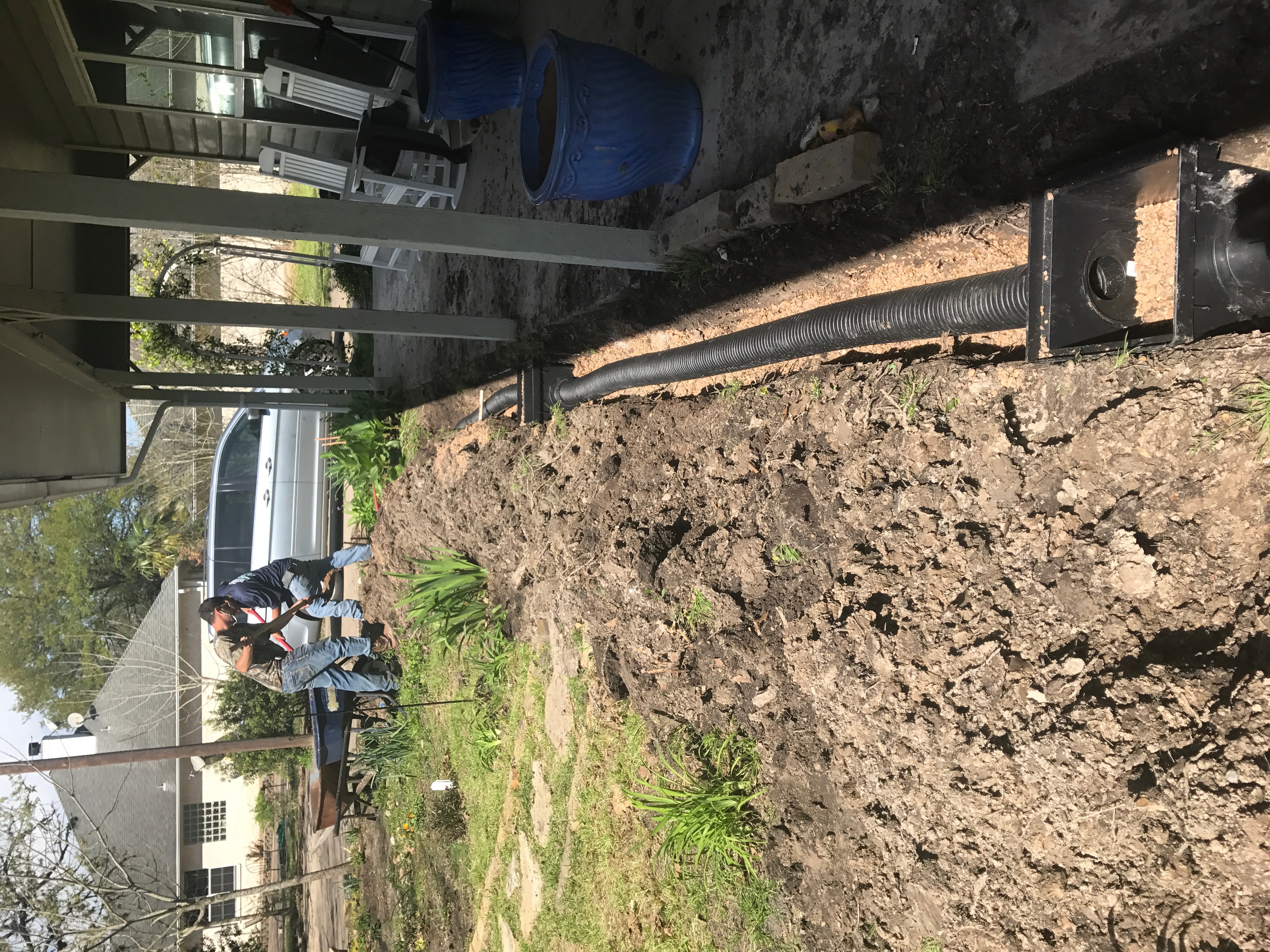
Short Answer: Proper yard drainage protects your home's foundation and prevents your lawn from turning into a swamp. In the Brazos Valley, where heavy spring rains meet clay-heavy soils, effective drainage usually requires a combination of French drains to manage subsurface water and catch basins to handle heavy surface runoff. The key to a successful installation is proper grading (a minimum 1% slope), using the right materials (like rigid PVC or high-quality corrugated pipe with a protective sleeve), and ensuring the water is routed far enough away from your foundation to prevent shifting.
If you live in Bryan or College Station, you already know the drill: when it rains in the spring, it pours. And thanks to the clay-heavy soil common throughout the Brazos Valley, all that water often has nowhere to go. It sits in your yard, turning the grass into a muddy swamp, or worse, pools against your home’s foundation.
Standing water is more than just an eyesore that ruins your landscaping. Over time, it can cause severe foundation shifting and structural damage. Fixing the issue requires a proper drainage system. Here is a guide on how to approach drainage installation the right way to protect your property.
Step 1: Identify the Source and Type of Water Problem
Before you start digging, you need to know exactly what kind of water issue you are dealing with. Drainage problems generally fall into two categories:
- Surface Water: This is water that pools on top of the grass after a heavy downpour. It is usually caused by improper grading or water rushing out of your gutters and downspouts with nowhere to go.
- Subsurface Water: This is water trapped beneath the surface, keeping the soil constantly soggy. It often happens in low-lying areas or yards with dense clay soil that doesn't drain well.
Understanding the difference dictates the solution. Surface water is best handled with catch basins and solid pipe routing, while subsurface water requires a French drain system.
Step 2: Choose the Right Drainage Solution
Once you know what you are up against, you can select the appropriate system. Often, the best approach is a combination of these methods.
French Drains
A French drain is the gold standard for managing subsurface water. It consists of a trench filled with gravel and a perforated pipe wrapped in landscape fabric. As groundwater rises, it enters the pipe and is safely carried away. This is incredibly effective for drying out perpetually soggy yards and protecting retaining walls or foundations.
Catch Basins
If you have localized flooding—like a low spot in the yard where surface water collects—a catch basin is your best bet. It acts like a storm drain for your lawn. Water flows into a grate at the surface and is piped away through a solid underground line.
Downspout Extensions
Many foundation issues start right at the roofline. If your downspouts are dumping hundreds of gallons of water directly next to your slab, you are asking for trouble. Connecting downspouts to solid underground pipes that route the water at least 10 feet away from the house is one of the most cost-effective ways to protect your foundation.
Step 3: Plan the Route and Check for Utilities
Water obeys gravity. Your drainage system must have a continuous downward slope to work. The industry standard is a minimum drop of 1 inch for every 8 feet of pipe (roughly a 1% slope). You need to identify a safe discharge point, such as a street curb, a designated drainage ditch, or a pop-up emitter in a lower part of the yard.
Crucial Step: Before a single shovel hits the dirt, you must call 811 to have underground utility lines marked. Hitting a gas, water, or electrical line will turn a landscaping project into an expensive and dangerous disaster.
Step 4: Trenching and Installation
This is where the hard work happens. For a French drain, the trench needs to be wide and deep enough to accommodate a layer of gravel, the pipe, and more gravel on top. Here is the proper sequence for a French drain that will not clog:
- Dig the trench with the correct slope.
- Line the entire trench with high-quality, non-woven geotextile landscape fabric. (Do not skip this, or dirt will clog the system).
- Add a base layer of washed gravel.
- Lay the perforated pipe (holes pointing down).
- Cover the pipe with more washed gravel until the trench is mostly full.
- Fold the landscape fabric over the top of the gravel to create a completely enclosed "burrito."
- Cover with topsoil and sod.
For solid pipes carrying water from catch basins or downspouts, rigid PVC is often preferred for durability, though heavy-duty corrugated pipe can work if installed carefully without sags where water can pool.
Step 5: Maintenance
A well-installed drainage system requires very little maintenance, but it isn't entirely set-and-forget. Keep catch basin grates clear of leaves and debris. Check pop-up emitters periodically to ensure they open freely and aren't blocked by overgrown grass. If you notice water backing up during a storm, you may need to flush the lines with a hose to clear minor sediment buildup.
When to Call a Professional
While extending a downspout might be a manageable weekend project, installing a comprehensive French drain or re-grading a yard requires heavy equipment, laser levels, and a lot of labor. If the water is threatening your foundation, it is best to leave it to the experts.
If you are tired of dealing with a soggy yard or worried about your foundation, give us a call at (979) 412-3624 or contact us online. At C&C Lawn & Irrigation, we specialize in custom drainage solutions for properties in Bryan, College Station, and the surrounding Brazos Valley.